First Steps After Noticing Signs of Autism: What Parents Need...
27/08/2026
Most children go through phases where they repeat things. The same song on repeat, the same game, and the same cup for every meal. That is just childhood. The question parents start asking is when that repetition stops being a phase and starts being something more. When repetitive behavior is frequent, difficult to redirect, and paired with communication or social differences, it may be an early sign worth discussing with a specialist.
Children learn through repetition. A toddler who repeatedly drops a spoon from his high chair is not trying to be difficult. That toddler is figuring out what happens every single time the spoon falls. A three-year-old who wants to watch the same cartoon for the tenth time in a row is not being stubborn. The familiarity feels good, and the child knows exactly what is coming next.
This kind of repetition is doing real work in a child’s development. It builds memory. It helps children practice movements until those movements feel natural. It gives young children a sense of control in a world that is still very large and unknown to them. Repeating words and phrases is also how children start to get comfortable with language before they can use it confidently on their own.
This kind of repetition tends to be flexible. The child can stop when redirected, engage with something new when it becomes interesting, and shift between activities without significant distress.
The concern arises not from repetition itself, but from how that repetition looks and what surrounds it.
When a behavior appears with unusual intensity, happens far more often than is typical for a child’s age, is very difficult to interrupt, or starts to interfere with daily life and learning, parents should pay closer attention.
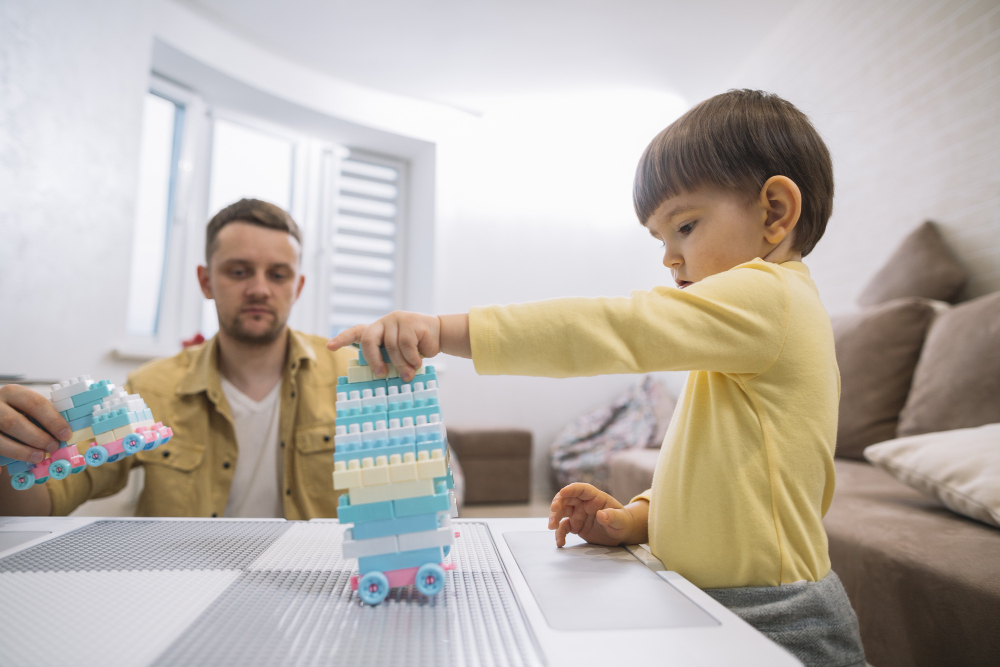
A child who lines up toy cars occasionally is playing. A child who lines toys up for extended periods, becomes very distressed when the arrangement is disrupted, and shows little interest in other types of play may be showing a pattern worth exploring, especially when other developmental disparities exist as well.
The difference lies in the pattern, not the behavior in isolation.
Repetitive behaviors do not all look the same. Some children move in repetitive ways. Others repeat words or get very attached to specific routines. Organizing these by category makes it easier for parents to recognize what they are actually seeing at home or hearing about from school.
You might notice your child flapping their hands when something exciting happens or rocking while sitting on the floor watching television. Some children spin in circles, jump repeatedly in the same spot, or walk on their tiptoes almost every time they move around the house. These movements are often called stimming, and they serve a real purpose for the child, even when they look unusual from the outside.
This one surprises a lot of parents. A child may spend a long time lining up every toy car in a straight row, then become very upset if anyone moves one. Another child might crouch down and stare at the spinning wheels of a toy rather than actually playing with it. Sorting objects by color or size, and opening and closing the same door or drawer again and again, also fall into this category.
Some children ask the same question repeatedly even after getting an answer. Others repeat full sentences or entire dialogues from their favorite shows, a phenomenon known as echolalia. This is not the child being cheeky or ignoring responses. For many children, repeating familiar phrases is a way of communicating or processing something they are feeling.
This is the category that often creates the most friction in family life. A child may insist on taking the exact same route to school every single day. Wearing a shirt with a tag might cause genuine distress, not a tantrum. Using a different cup at dinner can feel like a serious disruption. Changes to the bedtime routine, even small ones, can lead to significant anxiety for the child.
These behaviors are not signs of a badly behaved child or poor parenting. Children show these patterns for reasons that actually make sense once you understand what is driving them.
The DSM-5-TR lists restricted and repetitive behaviors as one of the two core criteria for an autism diagnosis. That is the clinical framing. But what does it actually mean for a child on an ordinary Tuesday?
Here’s an easier way to understand it.
Many autistic children experience the world through a nervous system that works differently. Sounds feel louder. Textures feel more intense. Unpredictable situations feel genuinely threatening rather than mildly uncomfortable. Repetitive behaviors are often the child’s way of managing all of that.
Rocking or hand flapping can calm an overwhelmed nervous system the same way an adult might pace the floor when anxious. Sticking to the same route, the same cup, the same bedtime order removes uncertainty from a day that can feel full of it. A child who repeats a phrase from a show might be using it to express something they do not yet have the words for.
Some repetitive behaviors are not about regulation at all. Some children genuinely love the sensory experience of watching something spin or feeling a specific texture. That is real enjoyment, not a symptom to eliminate.
Asha Susan Mani, BCBA, puts it this way: “Repetitive behaviors should always be interpreted alongside communication, social interaction, and developmental history, rather than in isolation. A behavior that looks the same in two children can mean something very different depending on the full picture.”
Understanding the reason behind the behavior changes how parents respond to it, and that shift in response can make a real difference in the child’s daily experience.
The American Academy of Pediatrics recommends developmental surveillance at every well-child visit and formal developmental screening at 18 and 24 months. Parents do not need to wait for a diagnosis to seek guidance.
Pay closer attention when repetitive behaviors are increasing over time rather than fading, when the child becomes very distressed if a routine or activity is interrupted, when repetitive behavior takes up most of the child’s day, when speech has slowed down or regressed, when the child shows little interest in other children, or when several of these differences are showing up together rather than just one on its own.
The Centers for Disease Control and Prevention (CDC) emphasizes that identifying developmental concerns early gives children access to the right evaluation and support sooner. Research consistently shows that early intervention leads to real improvements in communication, learning, and social connection for many children with autism.
If a combination of these signs feels familiar, do not wait to see if the behaviors settle on their own. Parents in Dubai and Sharjah who are noticing these patterns in their child’s nursery participation, daily routines, or communication development are better served by seeking a professional opinion early. An assessment does not commit a family to any particular path. It simply gives parents a clearer picture of what is happening and what support, if any, would actually help.
Repetitive behavior alone does not tell a clinician very much. What matters is everything around it.
When a child comes in for an autism assessment, the clinician is not running through a checklist. The clinician is watching how the child moves through the session, how the child responds when an activity is interrupted, whether sensory differences seem to be driving certain behaviors, and how the child communicates and connects with the people in the room.
Parents and teachers are a big part of this process too. What a clinician observes in a one-hour session is useful, but what a parent notices over months at home, or what a teacher sees in a classroom every day, adds context that no clinical observation can fully capture on its own.
It is also worth knowing that repetitive behaviors are not exclusive to autism. Children with anxiety, sensory processing differences, or obsessive-compulsive disorder can show very similar patterns. That is exactly why a thorough evaluation matters. The clinician is not looking at one behavior in isolation. The clinician is looking at the full picture of how a child develops, communicates, plays, and responds to the world around them.
Parents do not need a diagnosis in hand to start making things easier at home.
Notice when the behavior happens most, what was going on just before it started, and whether something specific seems to set it off. That information tells parents a lot more than guessing does, and it also becomes genuinely useful when a specialist asks about the child’s patterns.
Stopping a behavior mid-flow almost always makes things worse. A five-minute heads-up before moving on, something as simple as “we are finishing up in five minutes,” gives the child time to prepare instead of being caught off guard. That small change alone reduces a lot of the daily friction families deal with.
Children who struggle with change feel calmer when they know what is coming next. A consistent morning routine, a regular mealtime, a bedtime that follows the same steps each night. These do not need to be rigid to the minute, but the more consistent the structure, the less the child needs to seek that predictability through repetitive behavior.
These behaviors are not defiance. A child rocking or lining up toys is not acting out. Responding with calm rather than frustration keeps the child feeling safe, which is the foundation everything else is built on.
Early support does not change who a child is. Early support helps a child develop skills that make daily life easier and more connected.
Applied Behavior Analysis (ABA) therapy helps many children develop flexibility, manage transitions, and build functional communication skills, which may reduce the distress associated with rigid behaviors.
Occupational therapy looks at why a child’s body responds the way it does to the world around them. When a child rocks, flaps, or spins to cope with what they are feeling, an occupational therapist works on building other ways for that child to feel regulated and settled.
Speech therapy goes beyond teaching words. When a child repeats lines from shows instead of talking to people, or asks the same question twenty times without it feeling like a real conversation, a speech therapist helps that child find language that actually connects them to the people around them.
The brain develops fastest in the early years, and that window matters. A child who gets the right support during that time has a much better chance of building the skills that make school, friendships, and daily life feel manageable.
Repetitive behavior in children exists on a wide spectrum, from completely typical developmental patterns to behaviors that signal a child needs more support. No single behavior confirms or rules out autism. What matters is the full picture, including how a child communicates, connects with others, and responds to the world.
If a child shows several of the patterns described here, and especially if communication or social differences are also present, the next step is a professional evaluation. Early assessment is not about labeling a child. Early assessment is about understanding a child well enough to give the right support at the right time.
Honestly, repetition on its own is not the problem. Most kids repeat things, and that is just how they learn. What starts to matter is when the behavior is really hard to stop, takes up a big chunk of the day, or comes with other things like delayed speech or very little eye contact. If you are seeing a few of these things together, it is worth getting a professional opinion rather than sitting on it.
Toddlers line things up sometimes, and that is fine. But if lining up toys is basically all your child does during play, if changing the arrangement causes a big meltdown, and if your child does not seem interested in any other kind of play, that is a pattern worth talking to someone about. It does not mean autism automatically, but it is not something to brush off either.
Take it seriously. Teachers spend hours with children every single day across all kinds of situations, and when a teacher flags something, it usually means the behavior is noticeable enough to stand out in a room full of kids. If a teacher at a CBSE school in Deira or nearby has raised this, the next step is booking a developmental evaluation, not waiting to see if the teacher brings it up again.
Hand flapping when excited is something a lot of young children do, and by itself it does not signal a problem. The fuller picture matters more. If hand flapping is happening constantly throughout the day, in all kinds of situations, is very hard to redirect, and sits alongside things like limited communication or social withdrawal, then those extra pieces together are what make it worth looking into.
Asha4Autism covers families coming from Karama, Bur Dubai, Mankhool, and the areas around them. Asha Susan Mani, BCBA, leads the team and has worked with families from across Dubai and Sharjah. The easiest way to get things moving is to reach out through the website or drop a message on WhatsApp.
Not necessarily, but it is worth understanding. Repeating lines from shows is called echolalia, and it shows up in both typical development and autism. The key question is whether those repeated phrases are getting in the way of real communication. If your child mostly echoes rather than having actual back-and-forth conversations, and that pattern has been going on for a while, an assessment makes sense.
Most of the time, no. When a child rocks, flaps, or spins, that behavior is usually serving a purpose, helping them feel calm, handle a loud environment, or process something overwhelming. Stopping it without understanding why it is happening can actually make things harder, not easier. A behavioral therapist can watch your child, understand what is driving the behavior, and then figure out what kind of support would actually help.
There is no single answer here because every child is different. Some families start seeing small but real changes within a few months. Others need longer, and that is completely okay. The one thing that consistently makes a difference is starting early. The younger a child is when support begins, the more the brain can benefit from the right kind of help.
Yes, it does. A lot of children hold it together at school because the routine and structure there feel predictable and safe. Then they come home and release all of that tension through repetitive behaviors or meltdowns. That pattern is more common than most parents realize. A clinician looks at behavior across all settings, so what happens at home is just as relevant as what happens at school.
This comes up a lot, and it is a real and valid concern. Asha4Autism works with families to find session times that actually fit around work and school. The clinic is reachable from Bur Dubai, Karama, and Mankhool, and the team is happy to talk through scheduling before you even commit to an appointment. You do not have to figure that part out alone.
There is no age that is too early to raise a concern. The American Academy of Pediatrics recommends developmental screening at 18 and 24 months as a standard, but if something feels off before that, a conversation with a specialist is always appropriate. A child under two showing persistent repetitive movements alongside limited communication does not need to wait until the next scheduled checkup.
Ask the nursery to write down what they observed, specifically what the behavior looked like, how often it happened, and in what situations. Take that information to a developmental specialist and book an evaluation. Nursery staff observe children in group settings every day, which gives them a useful perspective that parents at home may not always have access to.
No, a diagnosis is not required. If repetitive behaviors are getting in the way of learning or daily life, therapy is still an option. ABA, occupational therapy, and speech therapy all focus on what the child needs right now. A formal label does not have to come first.
This is a worry a lot of parents carry quietly, and it is completely understandable. Therapy done well does not flatten a child’s personality or take away what makes them who they are. The goal is to build skills that make daily life feel more manageable and connected. Asha Susan Mani and the team at Asha4Autism work from a child-first position, which means the child’s individuality stays at the center throughout.
What you notice at home matters, and any good clinician will ask you about it. But watching your child at home only shows one piece of the picture. A formal assessment uses specific clinical tools and structured observation to catch patterns that are genuinely hard to spot without the right training. Both work together. Neither replaces the other.
Sorting and arranging by color, size, or type is one of the play patterns that comes up frequently in autism evaluations. When this kind of play dominates most of a child’s time, when the child gets very distressed if something is moved, and when imaginative or social play barely features at all, that combination is worth raising with a specialist. One behavior in isolation rarely tells the full story, but the pattern matters.
Yes. Families from Deira, Bur Dubai, Karama, and Sharjah all come to Asha4Autism for both assessments and therapy. Having both under one roof means parents do not have to manage multiple providers across different locations. You can message the team on WhatsApp or through the website to ask any questions before booking, and the team will walk you through what to expect.
Start by observing. Write down when the behavior happens, roughly how long it lasts, and what was going on before and after. When transitions are coming up, give your child a heads-up a few minutes in advance rather than stopping things suddenly. Keep the daily routine as predictable as you can. These things will not replace professional support, but they reduce friction at home and give the clinician genuinely useful information.
Some mild repetitive behaviors that are part of typical development do fade naturally over time. But when repetitive behaviors are connected to autism or other developmental differences, they tend to continue and sometimes increase without the right support. If you are genuinely unsure what you are looking at, an assessment gives you a clear answer and a direction to move in.
It is straightforward. Visit the Asha4Autism website or send a WhatsApp message and someone from the team will get back to you. Families from Karama, Bur Dubai, Mankhool, and Deira come through regularly. Before the first appointment, the team will explain exactly what the assessment involves so you walk in knowing what to expect, not guessing.