Repetitive Behavior in Children: What It Means and When It...
10/08/2026
Most parents don’t arrive at a doctor’s office with a printed checklist. They arrive with a feeling. Something quiet but persistent that says their baby seems different. The baby seems content and even happy but rarely looks over to share a smile. The baby doesn’t turn when called by name. The baby watches the ceiling fan for long stretches but shows little interest in the people nearby.
That feeling is worth listening to. Not because it confirms anything, but because autism red flags before age 2 are often subtle, and parents are frequently the first to notice them.
The earlier families recognize these patterns, the earlier children can access support that genuinely makes a difference. This guide is designed to help parents understand what to watch for, what does not automatically signal autism, and when professional evaluation becomes the right next step.
During the first two years of life, your child’s brain develops faster than at almost any other stage. This rapid growth supports communication, learning, play, and social interaction. Because so much development happens during this time, even small differences in these areas can become easier to recognize and discuss with a developmental specialist.
The American Academy of Pediatrics recommends autism-specific screening at 18 and 24 months because those two windows catch the most children who need further evaluation. Most routine pediatric checkups include this, but parents do not always know to ask about it by name. The CDC also highlights that recognizing developmental differences early allows families to access appropriate support during an important stage of development.
This is why professionals encourage parents not to ignore ongoing developmental concerns. If several differences continue over time, seeking an evaluation early can help families understand what support, if any, may benefit their child.
Autism looks different in every child. No two children on the spectrum present identically. That said, consistent patterns appear across research and clinical observation. These patterns fall across five areas that parents and caregivers are well-positioned to observe at home.
Babies are naturally social from birth. Typically developing babies seek eye contact, smile in response to familiar faces, and participate in back-and-forth social moments. Some parents later describe their baby as happy and content but less likely to share smiles, eye contact, or other back-and-forth social interactions.
Observations worth noting include:
Communication begins long before words do. Babies communicate through gestures, facial expressions, sounds, and gaze. When these early building blocks are absent or limited, the absence can signal differences in how the brain is processing social information.
Observations that specialists take seriously:
How a child plays reveals a great deal about cognitive and social development. Children on the spectrum often play differently, not because they are uninterested but because their brains engage with objects and environments in a different way.
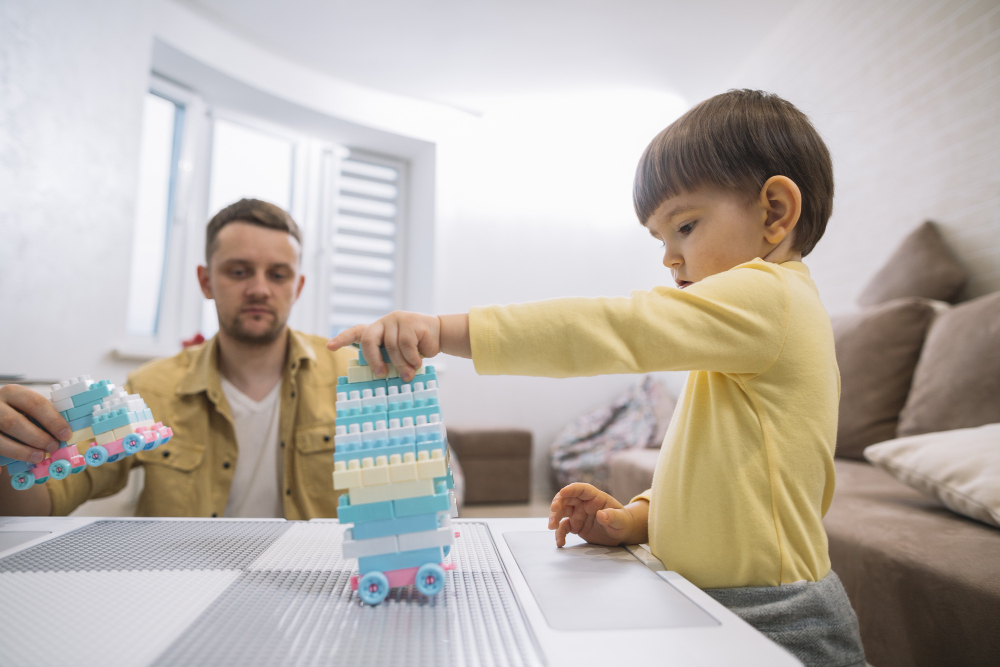
A lot of parents mention that their toddler could spin the wheels on a toy car for twenty minutes straight but had no interest in actually playing with the car. Some children do this with other objects too, lining things up in a specific order or getting upset when the arrangement changes. None of that automatically means autism. But when it keeps happening alongside other things, like not responding to name or avoiding eye contact, it is worth bringing up with someone qualified to assess it.
Ordinary sounds like a vacuum cleaner or mixer may cause an unusually strong reaction in some babies, while other children barely notice them. Some children react strongly to certain textures, lights, or physical contact. Others seem to notice very little of what is happening around them. Both patterns appear in children on the spectrum, and both are worth mentioning to a specialist.
Repetitive body movements such as hand flapping, rocking, spinning in circles, or persistent toe walking appear in some children on the spectrum. These behaviors do not confirm autism on their own, but when they appear alongside social communication differences, they form part of a broader picture worth evaluating.
It is important to remember that many children may show one or two of these behaviors during normal development. Specialists become more concerned when several differences appear together, continue over time, and affect everyday communication or social interaction.
If you notice several developmental differences happening consistently over weeks or months, consider speaking with a developmental specialist instead of waiting to see if your child simply outgrows them.
| Typical Development | Possible Autism Red Flag |
| Smiles back during interaction | Rarely smiles in response to others |
| Looks where a parent points | Does not follow a pointing gesture |
| Responds consistently to name | Rarely or inconsistently responds to name |
| Uses gestures to communicate | Limited or no use of gestures |
| Engages in back-and-forth play | Plays alongside others without engaging with them |
| Interested in other children | Consistently prefers objects over people |
Not every behavior on this list points to autism. Children develop at different rates, and some variation is entirely expected.
A child who is shy or slow to warm up in new environments is not necessarily showing social communication differences.
A child going through a significant change at home, such as a new sibling or a relocation, may temporarily show shifts in behavior.
A child with hearing loss may not respond to their name not because of social differences but because of how sound is being processed.
A single behavior rarely tells the full story. Developmental specialists assess communication, social interaction, play skills, behavior, and developmental history together before recommending further evaluation or making a diagnosis.
The distinction between typical variation and a genuine developmental difference is something a qualified specialist is trained to assess. Parents are not expected to draw that conclusion without professional support.
The question most parents ask is not what signs to look for but how to know when to act.
The answer comes down to patterns. One instance of a child not responding to name is not a cause for alarm. A consistent pattern across multiple settings and over several weeks is a different situation. When several behaviors appear together and persist rather than resolve, a developmental evaluation becomes the appropriate next step.
The behaviors that developmental specialists consider most significant include:
Loss of skills always warrants immediate professional attention, regardless of age.
Rather than matching a list of symptoms, parents often find it more useful to reflect on everyday observations. The following questions can guide that reflection.
These questions are not a diagnostic tool. They are a starting point for a productive conversation with a developmental specialist.
Developmental evaluations before age two typically involve direct observation of the child during structured and unstructured play. The specialist also gathers detailed information from parents about the child’s history, routines, and behaviors at home.
Standardized tools such as the Modified Checklist for Autism in Toddlers, Revised (M-CHAT-R) are used at 18 and 24 months as part of routine pediatric care. A positive screen does not confirm autism. A positive result means further evaluation is recommended.
A comprehensive developmental evaluation considers communication, social interaction, play skills, adaptive behavior, and developmental history. Depending on the child’s needs and the clinical setting, more than one specialist may be involved in the assessment process.
Many parents are told their child is “too young” to be evaluated, or they are advised to wait and see. This guidance does not reflect current clinical evidence.
Parents who started early often say the same thing: they wish they had not waited. Children in this age group are still building the very skills that therapy targets, which means the support lands during the exact window it is most useful. That window does not stay open indefinitely.
Delaying an evaluation can also delay access to services that may support communication, learning, and everyday development. Even if an assessment shows that a child is developing typically, parents gain reassurance and clear guidance about what to watch for next.
At Asha4Autism, families receive individualized developmental evaluations designed to understand each child’s strengths, communication, social interaction, play skills, and overall development. Led by Asha Susan, the team works closely with parents to identify developmental differences early and recommend appropriate next steps based on each child’s unique needs.
No parent should have to sit with that uncertainty alone. If what you have read here sounds like your child, the most useful thing you can do right now is talk to someone who can actually observe your child and give you a real answer. Asha4Autism offers developmental consultations and autism assessments for families in Dubai and Sharjah. That first conversation costs nothing except a little courage to make the call.
This is something many parents in Dubai ask, especially when friends and family keep saying “every child is different.” Personality and developmental differences do look similar on the surface. The thing to watch is whether the quietness is paired with other things, like not responding to their name, not pointing, or not making eye contact during play. If several of those things are happening together, it is worth getting a professional opinion rather than waiting.
Pointing to share interest, not just to grab something, usually develops by 12 to 14 months. We see this come up often with families whose children otherwise seem fine at home. If your child is not pointing by 14 months, that is a specific milestone worth mentioning to a developmental specialist. It does not mean autism is confirmed, but it is not something to set aside either.
Asha4Autism is in Karama, so it is genuinely convenient if you are coming from Bur Dubai, Mankhool, or Deira. Asha Susan Mani handles the evaluations personally, and a lot of families we speak to say they were relieved to find something this close without having to drive across the city.
A nursery teacher raising concerns at a parent-teacher meeting is actually one of the most useful early alerts a parent can receive. Teachers see children in group settings every day, which gives them a different view than home. Take the feedback seriously and follow up with a developmental specialist. Acting on it early is far better than dismissing it.
Both are possible, and both are worth ruling out. A hearing test is usually the first step because it is simple and straightforward. If hearing is fine and the name response is still inconsistent across different settings, a developmental evaluation is the right next step. The two assessments together give a much clearer picture.
Eighteen months is actually exactly the right time. The American Academy of Pediatrics recommends autism-specific screening at 18 months and again at 24 months. Asha4Autism offers developmental evaluations for children in this age range. Waiting until a child is older is one of the most common reasons families miss the early intervention window.
It could be one of several things, and a classroom setting adds its own layer of complexity. Children with early developmental differences often struggle with group instructions because those situations require following social cues, not just language. A developmental evaluation can help separate what is going on and point the family toward the right support.
No referral is required to contact Asha4Autism directly. Many parents in Dubai reach out after a nursery concern, a personal observation, or a recommendation from another family. Asha Susan Mani and the team will guide families through the right next step after an initial consultation.
The length of a developmental evaluation depends on your child’s age, developmental needs, and the information that needs to be gathered. Some children complete the process in one visit, while others may need additional observation or follow-up sessions to provide a complete picture. The process is thorough by design. Rushing it leads to incomplete pictures. Asha4Autism walks families through what to expect before anything begins.
Hand flapping by itself is something a lot of toddlers do when they are excited or overwhelmed. It does not automatically mean anything. What Asha Susan Mani and the team look at is whether it keeps happening alongside other things you are noticing, like your child not turning when you call their name, or rarely making eye contact. One behavior on its own is usually not the concern. The full picture is.
If possible, having both parents attend can provide a more complete picture of your child’s development, although one parent can also attend if work or family commitments make that easier. The specialist will gather information from whoever knows the child best and discuss the next steps with your family.
Most parents have never heard the term until a specialist says it in a consultation. Joint attention is simply when a baby spots something, a dog, a balloon, a ceiling fan, and then turns to look at the parent as if to say “are you seeing this too?” That back-and-forth moment is actually how babies learn to connect with people. When a child rarely does that by around 12 to 14 months, it is one of the things specialists pay close attention to.
Yes, and that difference is worth paying attention to. A lot of parents count words and feel relieved when the number looks okay. But specialists also look at whether a child uses words to connect, not just to ask for things. If your daughter is mostly saying words to get what she wants but not really chatting or sharing moments with you, bring that up with a developmental specialist.
Research does suggest that autism presents differently in some girls, and that girls are sometimes diagnosed later because their differences can be less obvious in early childhood. If a family has concerns about a daughter, those concerns deserve the same professional attention regardless of gender. Early evaluation gives the clearest picture.
Asha4Autism works with families at every stage, including families who are simply not sure and want professional guidance. A developmental evaluation does not require a prior diagnosis. Many families come to Asha Susan Mani with a feeling that something is different and leave with a much clearer understanding of their child’s needs.